From 50% grades and zero peers to shipping AI products and beating 30,000 applicants for the OpenAI hackathon.
By Dhruvil Mistry • June 2026

[01] the beginning
I grew up in Mumbai. Since childhood, I was what you’d call a builder.
My uncle used to give me those mechanical kits where you assemble small cars piece by piece. I’d sit for hours making them, completely fascinated by how individual parts came together to create something that actually moved.
That fascination never left. I moved from mechanical kits to Lego blocks, then to remote control cars I’d disassemble just to tinker with the motors. I still do car photography and spot cars everywhere. It’s just part of who I am.
Engineering curiosity is what really stuck, though. That mindset started developing in 6th, 7th standard: building things, taking them apart, wondering how they worked.
[02] the rock bottom moment
In 8th and 9th standard, things went sideways. I was completely distracted by cricket, hobbies — everything except academics. I just couldn’t focus on studying.
9TH GRADE FINAL SCORE
50%
SELF-TAUGHT RECOVERY
86%
That’s the moment that changed everything. I looked at my report card and realized I didn’t even understand the fundamentals. So I did what any confused 14-year-old does: I started teaching myself. No tuition, no coaching. Just me, textbooks, and stubbornness.
By my final exams, I had climbed to 86%.
[03] the trade-off
Then came 10th board exams. I was so focused on getting academics right that I literally gave up everything else for an entire year. No cricket, no real hobbies.
Result? 81%.
Not what I expected. I thought I’d score 90+. But that taught me something important: you can’t get everything in life. Sometimes you do your best and it’s still not “perfect.” That’s okay.
[04] the diploma decision
With 81%, I knew I wasn’t getting into a top computer science college. CS typically needed 90–95%, and I wasn’t there. But I didn’t want to abandon tech completely.
I started looking for an option that would give me the fundamentals I was missing AND exposure to software. That’s when I found Diploma in Electronics and Telecommunication Engineering at Thakur Vocational Training.
Looking back, it was one of the best decisions I’ve ever made.
[05] those years in college
I didn’t just attend classes. I went all in.
Joined the technical community and became Secretary. Participated in national-level contests and global coding challenges. Won first prize in a model-making competition. Secured 3rd rank in my entire Electronics and Telecom department, going from 70–80% to consistently hitting 90+.
Those were genuinely some of the best years of my life.
[06] degree’s heartbreak
After diploma, I needed a degree. There was one college I really wanted: Thakur College itself. I was confident, prepared, thought I had it.
I missed it by 1%. One lousy percent. I was devastated. But I had learned something from 9th grade: you can’t get everything in life. So I took the next best option, Rajiv Gandhi Institute of Technology, same field.
[07] tinkering with AI
While everyone was focused on regular engineering subjects, I was already deep in the AI rabbit hole.
I discovered the ChatGPT Playground and started asking it to write simple Python scripts, watching it hallucinate wildly. I was absolutely hooked: how does this thing work? How does it generate code? What’s happening under the hood?
So I started learning. The problem was, I didn’t have the fundamentals. I didn’t understand how computers worked at a deep level, so a lot of it went over my head. But I was too fascinated to stop.
I used to watch MKBHD, Arun Maini, Linus Tech Tips, Werktherapie. Tech was my thing, even if I couldn’t yet build anything impressive.
[08] twitter/x, the best place to be at
During my degree, I noticed something disappointing: none of my peers were curious about how AI actually worked. They were focused on other fields, and I was alone in this interest.
“You don’t need anyone’s permission to do something.”
— Someone on Twitter/XThat one sentence changed everything.
[09] bro started going to hackathons
I started participating in hackathons. Got selected into the world’s largest hackathon, Bolt.new’s, with a $1M+ prize pool. Made it to the semifinals and got knocked out.
But I found my community: people who were building, shipping, and curious about AI.
From there, I went all in. Participated in way too many hackathons, online and offline. Built a strong network on LinkedIn. Started posting my work on Twitter. Got a subject in AIML during my degree, finally the core knowledge I’d been missing.
[10] the hackathon that changed it all
Then came the OpenAI Hackathon. The one that genuinely changed things.
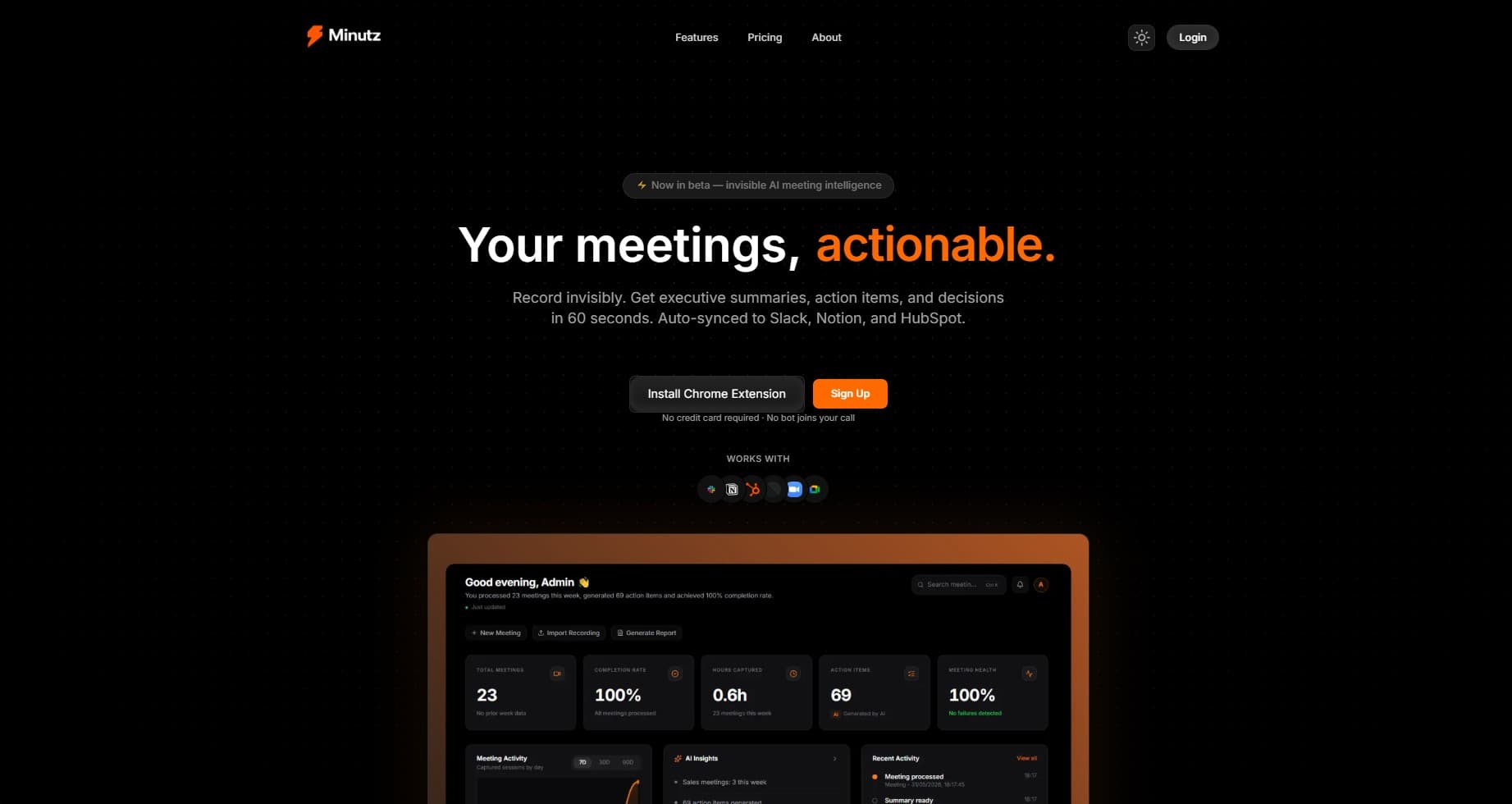
Out of 30,000–40,000 participants, only 1,000 were selected to build. I was one of them. And I built Minutz, an AI-powered meeting assistant Chrome extension.
Most meeting bots are intrusive. You join a Zoom call and suddenly there’s a bot recording everything — awkward, obvious, annoying. Minutz hides it. It captures audio from the browser tab (not a bot, invisible), chunks it into 10-minute segments, sends it to Whisper for transcription, then extracts key items and action items into a dashboard.
I built the entire thing (landing page, Chrome extension, dashboard, backend) in 7 days. The constraints made it better. Limited resources, mainly Codex and some free open-source models. That forced me to think deeper and ship faster.
I didn’t win. Only 5 winners out of 1,000. But I got connected with people actually shipping in the AI ecosystem, met people working at OpenAI’s level, and validated that I could build production-grade AI tools.
[11] why I build what I build
I see a lot of people using vision models to create flowers in their hands, or generating art mid-air. Those projects are cool. Zero offense.
But they’re not solving business problems.
What gets me going is building things that make someone’s life easier. Real use cases, real problems. That’s why I built Minutz. That’s why I’m continuing to build. I want to make an impact, not just make demos.
[12] what’s next?
Right now I’m finishing my portfolio website, actively exploring startup roles in the AI/LLM space, and building in public so others can learn from the journey.
I’m 21, in Mumbai, and just getting started.
If you’re 18, 19, 20 and feel behind: you’re not. The path is messy and nonlinear, full of 1-percent failures and 50% grades. But if you’re curious, building, and shipping, you’re already ahead.
Let's have a chat!
If you’re building in AI, working on hackathons, or want to chat about startups: